Thinking about Life and education with a focus on early Childhood
“This is one view of the nature of education, based on a conception of human nature … According to this conception, the child has an intrinsic nature, and central to it is a creative impulse … the goal of education should be to provide the soil and the freedom required for growth of this creative impulse … a complex and challenging environment that the child can imaginatively explore and, in this way, quicken his intrinsic creative impulse and so enrich his life in ways that may be quite varied and unique … governed, as Russell said, by a spirit of reverence and humility: reverence for the precious, varied, individual, indeterminate growing principle of life; and humility with regard to the aims and with regard to the degree of insight and understanding of the practitioners.” Noam Chomsky reflecting on philosopher Bertrand Russell’s humanist conception of education. (Chomsky, Otero 2003)
As an educator it would seem inevitable, given that we engage in a practice, a vocation, that demands we adopt a position that places children first. To take an ethical position means that we have to affirm that we are doing all we can to provide the best environmental circumstances to allow wholistic sensory and cognitive growth.
This is affirmed by the OECD (2006) report Starting Strong II: Early Childhood Education And Care proposing that the ‘social pedagogy tradition’ is one that best defines positively, a humanist approach within education systems,
“…The social approach is inherently holistic. The pedagogue sets out to address the whole child, the child with body, mind, emotions, creativity, history and social identity. This is not the child only of emotions – the psycho-therapeutical approach; nor only of the body – the medical or health approach; nor only of the mind – the traditional teaching approach. For the pedagogue, working with the whole child, learning, care and, more generally, upbringing … pedagogues seek to respect the natural learning strategies of young children, that is, learning through play, interaction, activity, and personal investigation. Co-operative project work is much employed to give children a taste for working together and to build up shared and more complex understandings of chosen themes. The belief is widespread that encouraging the initiatives and meaning-making of children strongly supports cognitive development.”
My Story
My journey toward early childhood education began with a significant personal event, the birth of my daughter – born in the month of December in 1990 – a decade which opened with the USA governments initiation of a new wave of invasion and war in Iraq. The latter decades and years of this century were marked by global shifts in power most significantly by the collapse of the all the former communist states. I did not know then just how profound the effect these events were to have on the struggle for social equality, and social welfare. After two decades one effect of collapsing Communist Parties is the significant absence of struggles for improved social wellbeing which has also boosted the neo-liberal, small government, market rule economists.
I remain an active socialist in the communist tradition and regard myself a Marxist. My ideas about class and socialism had found some purchase in my mind after a few years in the Royal Australian Navy. The hierarchical character of the armed forces was a rapid introduction to the larger issues of class and oppression that run through our societies. Decades latter a friend who was then an army intelligence officer, and an anarchist, articulated for me something I had understood but had not fully appreciated, the armed services in many ways is able to function because it relies on socialistic methods of organisation.
What has this to do with Early Childhood and education?
The collapse of communism and the influences of the Reagan and Thatcher era have been very disorientating politically as governments all over the globe sold-off our welfare to the corporations and so further concentrated ‘self-regulatory’ control and profits into fewer hands. As a labour movement activists I had to make sense of all this and seek new and different arguments and methods of organising. It was at this time that I came across the book ’Children First’ by Penelope Leach the British psychologist and child development and parenting expert. I vaguely knew of her, and was excited to see that someone who was a respected authority could write about the problems of capitalist society and its ill effects on children and human development generally.
“For our societies money is god, the market place is its temple and mass communications – from TV advertising to ‘motivational speakers’ – ensure that its creed is an inescapable driving force not just in corporate lives but in the lives of everyone of us.
With societies’ attention, energy and excitement focused on the marketplace, areas of human endeavour that cannot be directly bought with money and sold for profit tend to be regarded as peripheral. It may be thought worthy to work at personal relationships (as parents work to relate to their children and each other), but it will be usually considered more interesting to work at professional ones (as day care workers and marriage counsellors) – and get paid for it.”
“Children are a special case. Like the very old, the very young do not earn and therefore play little direct part in the marketplace. Indeed children are doubly unproductive because their maintenance and education cost money they cannot earn for themselves, and their care absorbs adult time that otherwise would be spent producing it. But because children are the producer-consumer units of tomorrow rather than yesterday, no economy can disregard them.” (Leach 1994)
Schooling and skills, is it education?
Preparing my daughter for school had a disturbing effect upon me that I had not expected. There were many good things about my school years but school itself was an indifferent experience. School had not built my confidence, if not undermining it, we sat in isolation while were encouraged not to speak unless spoken to, or asked a question, something to be avoided as it usually ended in humiliation. All said and done fertile ground for a sense of failure, as a teacher I vowed to improve on my experiences by not repeating them on the children in my care.
Studying and completing my degrees in Philosophy and Cinema Studies I then moved on into teaching. My semester in Philosophy with Children and the method of the community of inquiry, building out of Dewey’s conception of scientific inquiry, had given me fresh insights. This philosophical approach is a fine tool for facilitating children’s dialogue, engaging with each other in thinking about themselves and the world around them.
I have never had a desire to return to school, and this remains the case. I distinguish between schooling and education and I am sure I speak for many teachers who acknowledge their enjoyment of teaching as such, but find ‘the system’ vexing. Regulation enforcing minimum standards generally works to the detriment of improving and achieving best professional practice. Fenech, Sumsion, & Goodfellow (2006) used one educator’s description of regulation through the Quality Improvement and Accreditation System (QIAS) as “a double edged sword” because “notions of professional decision-making and practical wisdom are not readily identifiable in either QIAS or the NSW Children’s Services Regulation.
The chief concern I believe is the problem of regulations impinging on, or driving our pedagogical practice that is detrimental to children and is therefore not best practice. Pedagogues should begin with the question, who educates the educator? Any dialogue concerning the needs of children should begin here; what are the social, community and public needs of children generally, and the children with whom I work directly?
Love and learning
What can I do to develop their ‘Love of Learning’ that I believe that they initially come to me with? The mantras of ‘Life long learning’ and ‘learning readiness’ – within our formal institutions –suggests a view of learning that is knowledge transmitted down from the teacher, in contrast to the view that we have an innate predisposition to learn. How can we overcome or transcend the economic reductionism of the Corporate State that narrows the definition, purpose and possibilities of education?
To begin by asking, what do I have to do to be accountable to The State, is to unwittingly enforce the status quo and consequently the interests of the ruling class and the nation-market-state? Considering my position as an early childhood educator is one that needs to be regarded in terms of the real politic of education played out in each school under the auspice of education departments. As Bruer (1999) observes, politicians use ‘knowledge’ and ‘science’ to spin their gloss-over of practices detrimental to wholistic conceptions of early childhood education.
“Julia Gillard, the Deputy Prime Minister and Minister for Education, Workplace Relations and Social Inclusion, discussed ‘new’ knowledge…The new thinking that I’m talking about…is the new scientific research about the way children’s brains develop. …Gillard’s statement demonstrates how politicians can play a key role in framing and/or determining policy content and outcomes… Crucially, the quality of formal ECEC provisions for children also rests, to a considerable extent, on the policy decisions of politicians.
The problem is not so much one of science or developmental models opposing post modernist and humanist conceptions of education, but rather a crudely defined ‘medical model’ imposed on teachers and enforced through their practice. My experience of some school administrators is that they use counter reforming government demands, the use of regulations, and public service acts to enforce the medical model of testing, teaching to predetermined outcomes, and collecting quantifiable data as ‘evidence’ of ‘value adding’ to children.
Questions, questions, and more questions
The questions we should ask, how do educators defend best practice and research while they maybe dealing with draconian methods imposed by hierarchies, and unreasonable authoritarian methods at the departmental and school level? Who and what are educating the educator while they are being disciplined and undermined by those in authority? How do humanistic approaches that rely on qualitative means to measure personal achievements and growth flourish in this current period of reactionary politics?
Progressive approaches understand young children as ‘already human beings, with desires and powers of their own, and not as units of production and consumption, to be improved – potentially – for the benefit of the corporate profit-and-war machine. Part of the answer lies within ourselves as professional educators, by organising power into our collegiate and collective hands, so to build our profession and thereby serve the best qualities of all human kind.
References
Bruer, J.T. (1999) In Search of … Brain-Based Education, Phi Delta Kappan, 80(9), pp. 648-657, quoted in Brown, K., Sumsion, J., Press, F., Influences on Politicians’ Decision Making for Early Childhood Education and Care Policy: what do we know? What don’t we know?
Contemporary Issues in Early Childhood Volume 10 Number 3 2009, http://www.words.co.uk/CIEC
Chomsky, N. & Otero C. (2003) Chomsky on Democracy and Education Routledge pp. 163-4
Fenech, M., Sumison, J., Goodfellow, J., (2006) The Regulatory Environment in Long Day Care: A ‘double edged sword’ for early childhood professional practice, Australian Journal of Early Childhood, Vol. 31, No.3 September 2006.
Leach, P. (1994) People, Profits and Parenting, Children First: What society must do – and is not dong – for children today, Penguin, pp. 4-6
OECD (2006) A unified approach to learning: The social pedagogy tradition, Starting Strong II: Early Childhood Education And Care, p59
Words 17

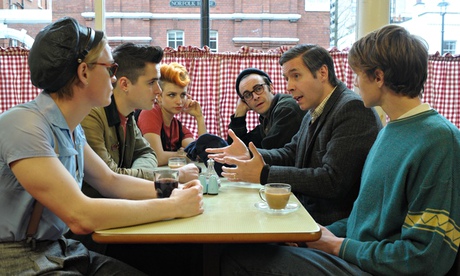 Left to right: Freddie Fox, Ben Schnetzer, Faye Marsay, Joseph Gilgun, Paddy Considine and George MacKay forge unity between lesbian and gay activists and striking miners in Pride.
  Critical Consciousness - Spirit of Paulo Friere