Archive for the ‘education’ Category

¿Está cambiando el sistema educativo?

March 14, 2015

ocioparapeques's avatarOcio para peques

Esta semana ha aparecido en diversos medios, una noticia que llama la atención “Los jesuitas eliminan las asignaturas, exámenes y horarios de sus colegios” (el diario.es, 5/03/2015).

ni.o.pintando.pared

La noticia nos pone en evidencia que algo está cambiando en el sistema educativo y que se está empezando a adaptar a la realidad actual. La idea del cambio en el sistema educativo la sostiene desde hace tiempo el escritor y educador británico Ken Robinson que defiende la necesidad de cambiar el sistema educativo actual que se creó en la época de la revolución industrial y de crear un sistema educativo que fomente los talentos naturales de cada uno de nosotros.

Ken Robinson dice en su libro titulado “El Elemento” lo siguiente: «Viajo mucho y me relaciono con personas de todas partes del mundo. Trabajo con instituciones educativas, con empresas y con organizaciones sin ánimo de lucro. En todas partes me encuentro con…

View original post 348 more words

Robert Putnam on the Crumbling American Dream

March 14, 2015

dianeravitch's avatarDiane Ravitch's blog

This is one of the most powerful articles I have read in a long time.

Robert Putnam describes life in his home town of Port Clinton, Ohio, population 6,059, as he was growing up in the 50s.

Port Clinton was “ a passable embodiment of the American dream, a place that offered decent opportunity for the children of bankers and factory workers alike.”

But today, “wealthy kids park BMW convertibles in the Port Clinton High School lot next to decrepit “junkers” in which homeless classmates live. The American dream has morphed into a split-screen American nightmare. And the story of this small town, and the divergent destinies of its children, turns out to be sadly representative of America.

“Growing up, almost all my classmates lived with two parents in homes their parents owned and in neighborhoods where everyone knew everyone else’s first name. Some dads worked in the local…

View original post 334 more words

Robert Putnam: Yes, Poverty Matters. It Matters a Lot.

March 14, 2015

This is what standardised testing, teacher quality debates, and everything else but social equality arguments are doing to us.

dianeravitch's avatarDiane Ravitch's blog

I recall reading Robert Putnam’s previous book, Bowling Alone, about the decline of civic life in America. It caused quite a stir. I am looking forward to reading his new book, Our Kids: The American Dream in Crisis. It seems certain to upset the “reformers,” as it blows away their assumptions that the schools are failing our children. As I read this review in Education Week, our society is failing our children, and we are not funding our schools in ways that help the neediest kids.

Sarah D. Sparks writes that Putnam “gathers a flood of research on the unraveling web of formal and informal supports that help students in poverty succeed academically and in life.

“If it takes a village to raise a child, the prognosis for America’s children isn’t good: In recent years, villages all over America, rich and poor, have deteriorated as we’ve shirked collective responsibility…

View original post 558 more words

Robert Putnam: When Did Poor Kids Stop Being ‘Our Kids’?

March 14, 2015

Robert Putnam: When Did Poor Kids Stop Being ‘Our Kids’?.

New Jersey Parent: The Movement is Growing

February 12, 2015

Engaging parents is critical

dianeravitch's avatarDiane Ravitch's blog

New Jersey parent and blogger Sarah Blaine (parentingthecore) describes the test rebellion brewing in her state:

“I have been so proud of my state ever since the January 7, 2015 State Board of Education open public comment period. We filled 4 rooms of testimony (in two buildings) that day. Almost 100 people spoke out against the PARCC, and that was just the tip of the iceberg.

“Trenton set the spark, and the press jumped on the bandwagon. We’ve had stories (that I’ve seen) about the PARCC refusal movement in The Star Ledger, on CBS News, in The Asbury Park Press, in The Alternative Press, in countless local papers, and the best TV coverage I’ve personally seen is this NJ Public Television/PBS-13 piece from earlier this week (and not just because I am interviewed in it via a terrible Skype connection to my iPad) http://www.njtvonline.org/news/video/legislation-addresses-parcc-test-controvery/ .

“Our Opt Out of State…

View original post 647 more words

Principal: Cuomo Has Turned Public Education into Public Enemy Number One

February 9, 2015

While this is comes from a principal in the USA it does make salient points regarding the Global Education (de) Reform Movement that the corporations are running to destroy public education. A must read.

dianeravitch's avatarDiane Ravitch's blog

Joey J. Cohen is principal of an elementary school in the Patchogue-Medford district in Long Island, New York, an area where parents are up in arms against high-stakes testing.

He wrote the following article and posted it on a school administrators’ blog. For a principal to speak out so forcefully about the misguided policies of the Governor and the Chancellor of the state Board of Regents takes guts. I am happy to place Joey J. Cohen on the blog’s honor roll for supporting public education, as well as the dedicated men and women who educate our nation’s children.

Misguided Direction
An Opinion Piece
By Joey J. Cohen, Ed.D., Principal – Patchogue-Medford School District
The future of education is not just in jeopardy with the current political climate set forth by Governor Cuomo, Chancellor Tisch and former Commissioner King, it is decidedly bleak. I have spent nearly twenty years in…

View original post 1,317 more words

Speak Out Against VAM for Ed Schools

January 28, 2015

dianeravitch's avatarDiane Ravitch's blog

Secretary Duncan wants to rate colleges of education by the test scores of students taught by their graduates.

Read this post by VAM expert Audrey Amrein Beardsley to learn why this is a very bad idea and how you can register your protest against it.

View original post

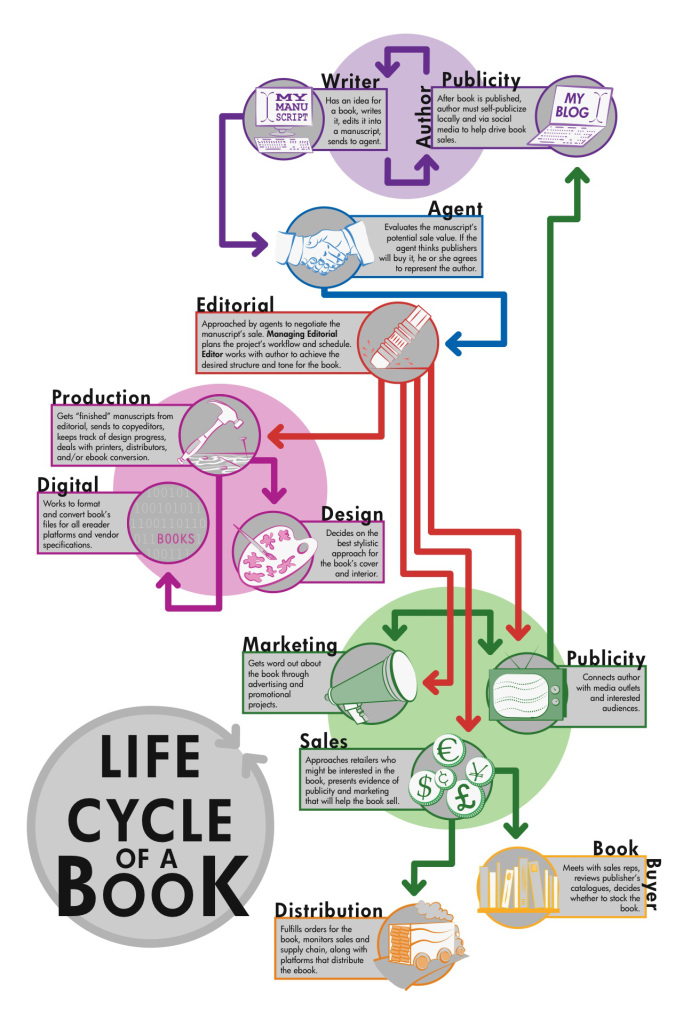
The Life Cycle of A Book

January 28, 2015

Good description of what happens if something you write is published. Still leaves a lot out however – like the need for an author to find a subsidy to help a book get published or otherwise expect to pay anything around $30K to $50K from you own pocket.

Sherry Chen's avatarPublishing Insights

Book-Cycle-FINAL

This picture illustrates the (traditional?) publishing process, which involves four major parties and twelve steps. If authors take the self-publishing approach, some steps (e.g. Agent) might be optional; if only e-book version is produced (whether on the author’s own website or under contract with publishing platforms like Amazon), then details of the Distribution step will also alter. In addition, the “Print on Demand” (POD) model is bound to have a great impact on the distribution process.

I personally think that these days it will be necessary to draw a direct link between “Writer” and “Book Buyer”/”Reader”. With online platforms like Goodreads, Amazon, and various blogging sites, writers and readers now can easily engage with each other in the life cycle of a book. Wouldn’t it be a great way to promote book sales if reading becomes more interactive?

Image Credict: International Book Promotion

View original post

Teachers forced to equip schools at own expense as austerity bites West Bank

January 24, 2015

Teachers forced to equip schools at own expense as austerity bites West Bank.

23 January 2015

Budgets are so tight that many Palestinian Authority schools cannot afford paper and pencils. Hard-pressed teachers must spend their own stagnating wages on supplies.

Ghadeer Rabi cannot remember a time during her five-year career as a high school teacher that her salary was enough to support her family. Without her husband’s income, the thirty-year-old says she would not be able to survive.

Rabi’s monthly paychecks are inconsistent, often coming as partial payments or none at all. The Ramallah-based Palestinian Authority “keeps promising us a lot, like raises, but we haven’t seen anything,” she told The Electronic Intifada.

Rabi’s situation is not unique: the PA and public servants in the occupied West Bank have been at loggerheads for years.

These problems show no sign of letting up, especially since Israel began withholding taxes it is supposed to transfer to the PA as part of the Oslo accords.

Israel is withholding $127 million worth of tax funds and customs duties on goods that pass through present-day Israel before being exported, as reported by Al Jazeera English earlier this month. The Israeli move has been taken in retaliation for the PA’s decision to join the International Criminal Court.

Withholding Palestinian tax transfers, which Israel has done as a punitive measure many times in the past, intensifies the already difficult economic situation for public and civil servants, among them teachers. In response to Israel’s withholding of tax money, Kenneth Roth, director of Human Rights Watch, said that “Western governments should refuse to follow suit [by imposing] their own sanctions” on the PA.

Wages stagnate

Living with her husband and infant daughter in Ramallah, Rabi teaches at the local Deir Jarir Girls High School and Mughtarabe Elementary School in the neighboring area of al-Bireh. The schools’ classrooms — which are overcrowded with upwards of forty students each period — lack heating, air-conditioning and most basic supplies.

Due to severe budgetary limitations, the twenty-eight teachers at Deir Jarir are often made to foot the bill for their own supplies, though more than 600 students attend the school. “We don’t even bother asking for additional supplies at this point,” said Rabi. “We know what the response will be.”

Aside from a one-time hourly wage increase of twenty shekels ($6) for the cost of living, “I have worked for five years and haven’t received a single raise,” Rabi said.

While the PA formally bans teachers from working a second job, Rabi said that most are forced to work elsewhere part-time.

Nidal Afafneh, a fourth-year English teacher at Anata Primary School in the West Bank, is one of those searching for a second job to supplement his income. “Some of my colleagues have even taken third jobs,” he told The Electronic Intifada. “This isn’t allowed, but they have to feed their kids.”

Afafneh, 26, said that teachers are demanding their basic rights, such as the school providing paper, pencils, and an annual salary increase to reflect the soaring cost of living, particularly in the Ramallah area. “Sometimes we don’t have electricity or water in our school for days at a time,” he added.

Israel’s harsh restrictions translate into stagnation for the Palestinian economy. In 2013, the World Bank estimated that Israeli control of the West Bank costs Palestinians some $3.4 billion each year. These restrictions have also created a dependency on foreign aid.

PA “dependent and fragile”

But critics also accuse the PA of rampant corruption. The lack of accountability within public institutions has led to widespread “embezzlement, money laundering, fraud, and exploitation of position for personal gain,” states a 2012 report by the Coalition for Integrity and Accountability, a Ramallah-based anti-corruption watchdog. “Those involved in these crimes were high-level employees, such as heads of government divisions, who were conspiring with lower and intermediate level employees.”

Alaa Tartir, program director of Al-Shabaka, a group that monitors Palestinian social and economic policies, explained that the 1993 Oslo Accords between Israel and the Palestinian Liberation Organization “created an inherently dependent and fragile Palestinian ‘authority.’”

After years of building up its public sector, the PA today has around 150,000 public servants, Tartir told The Electronic Intifada. “When Israel decides to withhold Palestinian taxes or when the PA passes through a financial crisis — which is recurrent — those monthly salaries get majorly delayed or paid in installments over months,” he said.

“When Israel withholds taxes it does indeed commit another form of ‘collective punishment’ because it does not only punish the civil servants but also their families [and] we are talking about hundreds of thousands of people that are affected,” Tartir continued.

Yet, the PA’s neoliberal economic policies have only worsened the situation. A Western-backed agenda “entrenched the structural deficiencies in the Palestinian economy and created further distortion,” said Tartir. “It increased inequalities, poverty and unemployment. It created a status of individual wealth for some but national poverty for all.”

Harming the poor

The PA “created a capitalist class that are benefiting from the status quo and arguably from the mere existence of the occupation,” he noted, adding that “entrenching the neoliberal policies will only help Israel’s occupation directly and indirectly through adding another layer of repression that particularly harm the poor and [hinders] their process of liberation.”

As the costs of housing, food and utilities continue to increase, the Palestinian economy remains largely stagnant. According to a World Bank report published in September 2014, unemployment in the West Bank sat at 16 percent during the first quarter of that year.

According to the Palestinian Central Bureau of Statistics, an estimated 23.1 percent of Palestinians in the West Bank and Gaza worked in the public sector during 2013. Of those, 16.4 percent were in the West Bank.

In addition to the punitive measures taken by the Israeli authorities, the constant disputes between the PA and teachers have resulted in several strikes over the last five years. Most of the more than one million students across the West Bank are affected, creating a difficult learning environment.

Citing the fall 2013 semester as an example, Ghadeer Rabi, the teacher, explained that there were several strikes, “making the actual class time very thin.”

“Strikes have made it a very difficult learning environment. Teachers go through the lessons really fast to catch up with what they miss,” she said. “And students aren’t motivated to be in class.”

Patrick O. Strickland is an independent journalist and frequent contributor to The Electronic Intifada. His website is www.postrickland.com. Follow him on Twitter: @P_Strickland_.

“Schools in Context”: The Full Text of a Major Study Comparing the U.S. to Eight Other Nations

January 21, 2015

“Schools in Context”: The Full Text of a Major Study Comparing the U.S. to Eight Other Nations.